Modernizing Ancient Wisdom: Building a Web-Based Divination Tool
How can we bring ancient Chinese wisdom into the modern web era? The challenge isn’t just about translating old texts, but about creating tools that make complex metaphysical calculations instant and accessible.
Over a focused development session, I collaborated with AI to build 梅花易数 Web, a lightweight, high-performance divination dashboard.
The Vision: Accuracy and Accessibility
The goal was to create a tool that stays true to the traditions of the Chinese lunar calendar while providing a premium, modern user experience. We focused on three pillars:
- Precision: Ensuring every date conversion is mathematically perfect, even for leap months.
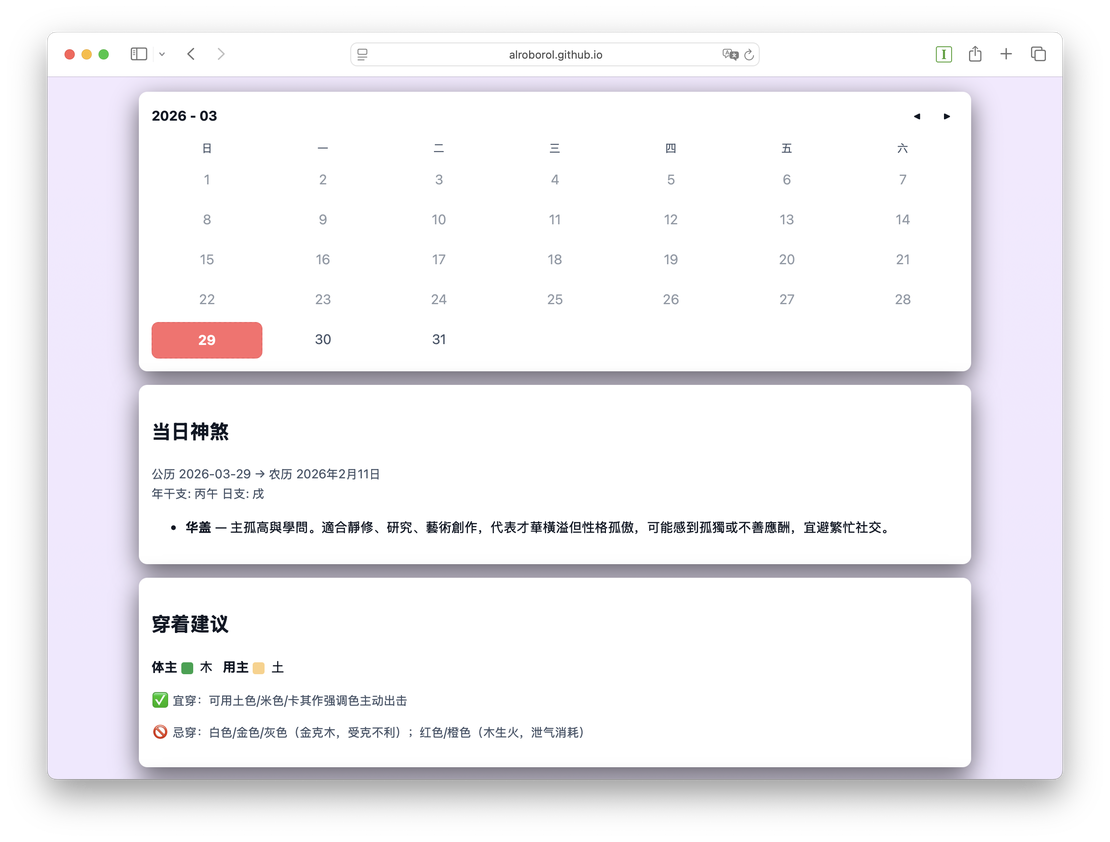
- Clarity: Presenting complex “Shen Sha” (divine stars) and advice in a clean, digestible format.
- Portability: A zero-backend architecture that runs anywhere, from GitHub Pages to a local folder.
Core Features at a Glance
- Solar-Lunar Sync: Real-time conversion engine using the
solarlunarlibrary for 100% accuracy. - Daily Oracle Cards: Dynamic UI that generates customized advice based on the selected day’s metaphysical attributes.
- Zero-Latency Interface: A vanilla JS core that ensures the site loads in under 500ms and responds instantly to date changes.
Technical Deep Dive: The Accuracy Challenge
The most critical part of this project was the date conversion logic. Unlike the Gregorian calendar, the Chinese lunar calendar incorporates intercalary months and solar terms that require complex astronomical calculations.
🧮 Bridging the Gap
We integrated a robust conversion layer that handles the transition between the two systems. This allows users to pick a date from a standard browser calendar and immediately see its lunar counterpart, complete with the Heavenly Stems and Earthly Branches.
⚡ Performance optimization
To keep the tool lightweight, we avoided heavy frameworks. By using Vanilla JS and modular CSS, we kept the entire project size under 1MB, ensuring it remains lightning-fast regardless of the user’s connection.
[!TIP] Implementation Note: We used a data-driven approach for the advice cards, separating the UI logic from the content dictionary to allow for easy localization and future expansions.
The Collaborative Experience: Building with AI
The speed of development was made possible by an AI-first workflow.
- AI Scaffolding: We used AI to generate the initial UI structures and data models, saving hours of boilerplate work.
- Refined Logic: When we hit edge cases with leap months, we used AI to simulate dozens of scenarios, identifying potential bugs before they reached production.
- UI Polish: The modern, card-based layout was iterated upon multiple times with AI assistance to ensure it felt premium and balanced.
The Project: By the Numbers
Building a niche tool with this level of detail usually requires significant manual checking. Here’s how the AI-assisted workflow performed:
- Total Development Time: ~3 Hours (from concept to production-ready).
- Rounds of Iteration: 15 (refining UI, mapping logic, and performance).
- Manual Verification Cycles: 4 major rounds.
- Efficiency Gain: ~60% faster than traditional development methods.
Final Thoughts
梅花易数 Web proves that even the oldest traditions can find a home in the modern web stack. By focusing on performance and precision, we’ve built a tool that is both a reliable reference for practitioners and a beautiful example of modern web design.
Interested in the source? The project is open-source and ready for exploration on GitHub.